
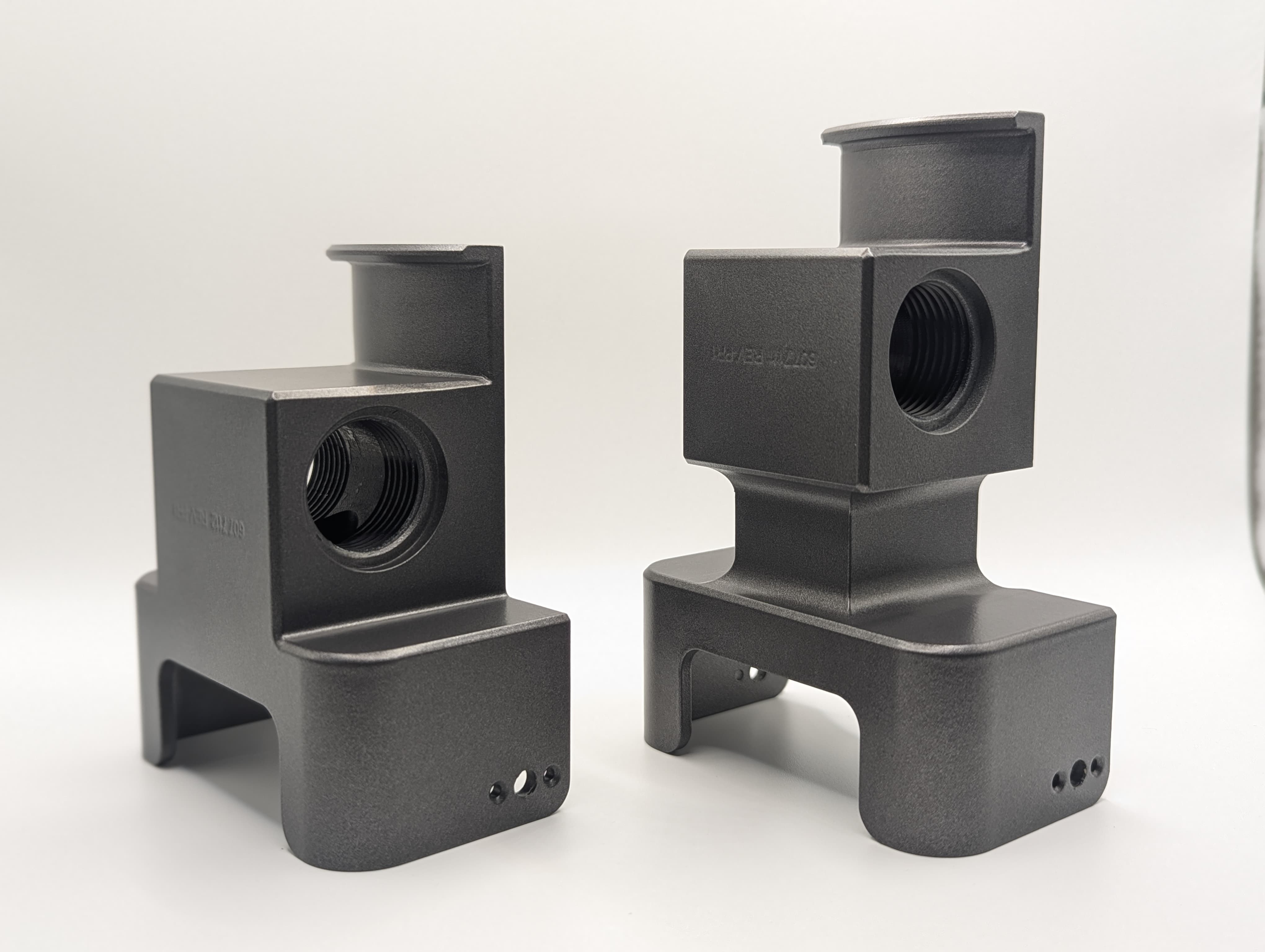
Precision CNC machining is only part of the story. Many of the components we manufacture require external processing — surface treatments, coatings, and finishing operations performed by specialized suppliers after machining is complete. These processes are critical to the performance, corrosion resistance, and longevity of the finished part, and managing them properly is just as important as the machining itself.
At Tru-Tech Precision, we coordinate all external processing on behalf of our customers, working through approved supplier lists and adhering to customer-specific requirements — including NADCAP accreditation where required. This article explains the most common external processes we manage and how our quality system ensures they are performed to the standards your program demands.
Common External Processes
Anodizing
Anodizing is an electrochemical process that converts the surface of aluminum parts into a durable, corrosion-resistant oxide layer. It is one of the most common external processes we manage for aerospace and commercial components. There are several types:
- Type II (Sulfuric Acid Anodizing): Produces a thin, decorative oxide layer that provides moderate corrosion resistance. Often used for commercial and non-critical aerospace components. Can be dyed in various colors for identification purposes.
- Type III (Hardcoat Anodizing): Produces a much thicker, harder oxide layer that provides excellent wear resistance and corrosion protection. Common on aerospace components subject to abrasion, sliding contact, or harsh operating environments.
- Chromic Acid Anodizing (Type I): A thinner coating that provides good corrosion resistance with minimal dimensional change. Preferred for tight-tolerance aerospace parts and components that will be adhesively bonded.
Anodizing specifications vary by customer and application. We ensure the correct specification (such as MIL-A-8625) is called out and that the processing supplier meets the required quality accreditations.
Passivation
Passivation is a chemical treatment applied to stainless steel and other corrosion-resistant alloys to remove surface contaminants — particularly free iron — that can compromise corrosion resistance. The process involves immersing parts in a nitric acid or citric acid solution, which dissolves surface impurities and promotes the formation of a uniform, protective chromium oxide layer.
For aerospace and nuclear components, passivation is typically performed in accordance with specifications such as ASTM A967, AMS 2700, or customer-specific requirements. It is a critical step for stainless steel parts that will operate in corrosive environments or must meet stringent cleanliness requirements.
Plating
Electroplating and electroless plating processes deposit a thin layer of metal onto the surface of a component to improve corrosion resistance, wear resistance, conductivity, or solderability. Common plating processes we manage include:
- Cadmium Plating: Widely used in aerospace for its excellent corrosion resistance and lubricity. Performed per QQ-P-416 or customer specifications.
- Nickel Plating: Provides corrosion resistance and wear resistance. Electroless nickel plating (per AMS 2404 or MIL-C-26074) is common for its uniform coating thickness on complex geometries.
- Zinc Plating: An economical corrosion-resistant coating commonly used on carbon steel components for commercial and industrial applications.
- Chrome Plating: Used for wear resistance and dimensional recovery. Hard chrome plating is common on hydraulic components and bearing surfaces.
Chemical Conversion Coating (Chem Film)
Also known as chromate conversion coating or Alodine, this process creates a thin protective layer on aluminum surfaces. It provides corrosion resistance, improves paint adhesion, and maintains electrical conductivity. Commonly specified per MIL-DTL-5541 (Class 1A for corrosion protection or Class 3 for electrical conductivity), it is frequently used on aerospace aluminum components either as a standalone treatment or as a primer for paint systems.
Heat Treating and Stress Relieving
Some components require heat treatment to achieve specific mechanical properties — hardness, tensile strength, or ductility — or stress relieving to remove residual stresses introduced during machining. These processes must be performed by qualified suppliers with calibrated furnaces and the ability to provide certifications that the specified thermal cycle was followed precisely.
Non-Destructive Testing (NDT)
External NDT services such as fluorescent penetrant inspection (FPI), magnetic particle inspection (MPI), and radiographic inspection are often required to verify that components are free of surface and subsurface defects. These inspections are critical for flight-safety and nuclear components and are typically specified by the customer drawing or purchase order.
Working with Approved Supplier Lists
In aerospace and other regulated industries, external processing cannot be sent to just any vendor. Customers typically maintain Approved Supplier Lists (ASLs) — also called Qualified Supplier Lists — that specify which processing houses are authorized to perform particular treatments on their components.
At Tru-Tech, we work directly with our customers' approved supplier lists. When a purchase order specifies external processing, our process is straightforward:
- We verify the required processor: We review the customer's purchase order, drawing, and specification callouts to identify exactly which processes are required and whether specific approved suppliers are mandated.
- We use the customer's approved sources: If the customer specifies that anodizing must be performed by a particular facility, or that plating must go to a NADCAP-accredited processor, we route the work accordingly. We do not substitute processors without customer authorization.
- We maintain our own approved supplier list: For customers who do not mandate specific processors, we maintain our own evaluated and approved list of external processing suppliers. These suppliers are assessed for quality, capability, delivery performance, and relevant certifications before being added to our approved list.
- We coordinate logistics and documentation: We handle all transportation, packaging, and paperwork between our facility and the external processor. When parts return, we verify that processing certifications are complete and that parts meet all requirements before shipping to the customer.
NADCAP and Customer-Driven Requirements
NADCAP (National Aerospace and Defense Contractors Accreditation Program) is an industry-managed accreditation program that provides standardized assessments of special processes. When a customer requires NADCAP-accredited processing, it means the external processor has been independently audited and accredited specifically for that process — whether it is chemical processing, heat treating, coatings, NDT, or other special processes.
Many major aerospace OEMs and primes — including Boeing, Airbus, Pratt & Whitney, and others — require that special processes on their components be performed by NADCAP-accredited sources. This requirement flows down through the supply chain, and as a manufacturer, it is our responsibility to ensure compliance.
Here is how we handle NADCAP requirements at Tru-Tech:
- Flow-down compliance: When a customer's purchase order or specification requires NADCAP-accredited processing, we ensure the work is routed only to processors that hold current NADCAP accreditation for the specific process required. We verify accreditation status before placing orders.
- Documentation and traceability: We obtain and retain processing certifications from the NADCAP-accredited supplier, confirming that the work was performed in accordance with the applicable specification and that the processor's accreditation was current at the time of processing.
- Customer-specific requirements: Beyond NADCAP, individual customers may have additional requirements for external processing — specific test methods, sampling plans, reporting formats, or restrictions on sub-tier suppliers. We review and comply with all customer-specific requirements as part of our order review process.
Quality Control for External Processing
Sending parts out for external processing introduces risk — parts could be damaged in transit, processing could be performed incorrectly, or documentation could be incomplete. Our quality system addresses these risks at every step:
- Pre-processing inspection: Parts are inspected and documented before they leave our facility. This establishes a baseline and ensures we can identify any damage or issues introduced during external processing.
- Receiving inspection: When parts return from the external processor, we perform receiving inspection to verify visual appearance, coating thickness or quality where applicable, and review all processing certifications for completeness and accuracy.
- Certification review: Processing certifications are reviewed against the specification requirements and customer purchase order before parts are released for shipment. Any discrepancies are resolved before the parts move forward.
- Supplier performance monitoring: We track the quality and delivery performance of our external processing suppliers. Suppliers who consistently deliver on time with correct certifications and defect-free parts maintain their approved status. Issues are addressed through our corrective action process.
Why This Matters to You
When you send a purchase order to Tru-Tech, you are not just getting machining — you are getting a manufacturing partner who manages the entire process from raw material through finished, processed, and inspected parts. We take ownership of external processing coordination so that you receive a complete, ready-to-install component with all the documentation and certifications your program requires.
Whether your parts need anodizing, passivation, plating, heat treating, or NDT — and whether they require NADCAP-accredited sources or specific customer-approved processors — we have the systems and supplier relationships in place to manage it properly.
If you have questions about how we handle external processing for your specific requirements, contact our team.